
Learn About MIPS
Reporting Requirement
Scoring Logic
Understanding Quality Payment Program
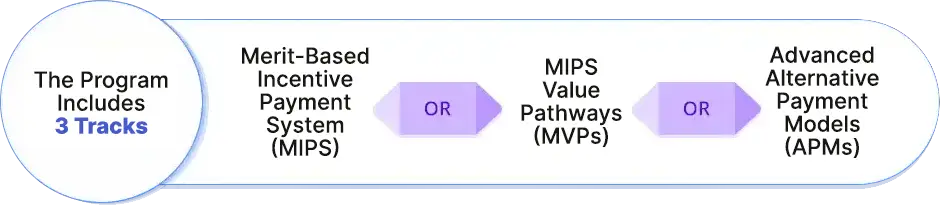
Clinicians may participate in the Quality Payment Program (QPP) through one of the three tracks — Merit-based Incentive Payment System (MIPS), MIPS Value Pathways (MVPs), or Advanced Alternative Payment Models (APMs).
Benefits of Quality Payment Program
The Quality Payment Program:
- Improve the care received by Medicare beneficiaries
- Lower costs to the Medicare program through improvement of care and health
- Advance the use of healthcare information between allied clinicians and patients
- Educate, engage and empower patients as members of their care team
- Provide accurate, timely, and actionable performance data to clinicians, patients and other stakeholders
For 2026, Merit Based Incentive Payment System (MIPS) is divided into 4 categories

QUALITY
30%
of Total MIPS Composite Score

PROMOTING INTEROPERABILITY
25%
of Total MIPS Composite Score

IMPROVEMENT ACTIVITIES
15%
of Total MIPS Composite Score

COST
30%
of Total MIPS Composite Score
Eligibility Criteria to Participate in MIPS 2026
Eligibility: A clinician is considered MIPS-eligible when all the following are true:
- The Clinician should be from the list of eligible clinician types; AND
- The Clinician had enrolled in Medicare before January 1, 2026; AND
- The Clinician is not identified as a Qualifying APM Participant; AND
- The Clinician exceeds all components of the low-volume threshold AND
- Types of Eligible Clinicians:
Certified Registered Nurse Anesthetists
Clinical Nurse Specialists
Clinical Psychologists
Nurse Practitioners
Occupational Therapists
Physical Therapists
Physician
Physician Assistants
Qualified Speech-Language Pathologists
Qualified Audiologists
Registered Dietitians or Nutrition Professionals
Osteopathic Practitioners
Chiropractors
Clinical Social Workers
Certified Nurse Midwives
Low-Volume Threshold Criteria for 2026:
- Bill more than $90,000 for Part B covered professional services under the Physician Fee Schedule; AND
- See more than 200 Part B patients; AND
- Provide more than 200 covered professional services to Part B patients; AND
General Exclusion:
- Clinicians who participate in an Advanced Alternative Payment Model (APM) entity and reach certain thresholds become Qualifying APM Participants (QPs) or Partial QPs. QPs and Partial QPs don’t need to participate in MIPS.
- MIPS eligible clinician can be excluded from participating in MIPS for the performance year if he/she is Enrolled in Medicare for the first time in the Performance year.
Eligibility for Opt-In: Eligible Clinicians or groups can opt-in to MIPS, if they meet or exceed at least one, but not all three, of the low-volume threshold criteria.
Eligible Clinician can participate in MIPS as an Individual, Group or Virtual Group*
It is finalized that all MIPS eligible clinicians, including those in a MIPS APM, may choose to participate in MIPS as:
- An individual
- A group
- A virtual group
- An APM Entity
Virtual Groups in 2026: Virtual groups report through traditional MIPS only; MVPs and the APP are not available as reporting options for virtual groups.
*Definition: Virtual groups are a combination of two or more Taxpayer Identification Numbers (TINs) composed of a solo practitioner (individual MIPS eligible clinician who bills under a TIN with no other NPIs billing under such TIN), or a group with 10 or fewer eligible clinician under the TIN that elects to form a virtual group with at least one other such solo practitioner or group for a performance period for a year.
Beginning of Performance Period
Eligible clinicians can choose to participate in MIPS from January 1, 2026
- For Quality and Cost categories a full year (12-month) performance period is considered. No submission is required for the Cost category since this will be calculated by CMS.

JAN 1 2026 Starting period
- For IA category, Eligible Clinicians can choose any 90 consecutive day time frame starting from January 1 – October 3, 2026, to report performance for.

- As finalized starting PY 2026, for PI category, Eligible Clinicians can choose any 180 consecutive day time frame starting from January 1 – July 5, 2026, to report performance for.
- CEHRT functionality that meets ASTP/ONC’s health IT certification criteria must be in place by July 5. EHR must be certified by ASTP/ONC to the health IT certification criteria by the end of Performance Year, December 31.

Understanding Payment Adjustments for MIPS 2026
If an eligible clinician participates in MIPS, the clinician receives performance based payment adjustment according to the final score calculated from the data submitted.
The payment adjustment may be neutral, positive or negative depending upon the threshold score.
Opt-in eligible clinicians are also eligible to receive payment adjustments as per their performance. However, clinician reporting voluntarily do receive feedback but not a payment adjustment.
The payment adjustments are applicable to the Medicare Part B services provided 2 years after the performance year. For example, the 2026 score will be used to calculate reimbursement of Medicare Part B claims in 2028.
Payment Adjustment: Payment adjustment for the 2026 performance year ranges from – 9% to + 9% as per the CMS 2026 final rule. The scaling factor is determined in a way so that budget neutrality is achieved. The payment adjustment is applied to the amount Medicare Part B claims.
The complex patient bonus is driven by:
- Clinicians who have a median or higher value for at least one of the two risk indicators (HCC and dual proportion).
- The formula standardizes the distribution of 2 two risk indicators so that the policy can target clinicians who have a higher share of socially and/or medically complex patients.
- The bonus is a maximum of 10.0 points.
Submission Types for 2026
Submission Type is the mechanism by which the submitter type submits data to CMS:
- Direct (transmitting data through a computer-to-computer interaction, such as an Application Program Interface, or API);
- Sign in and upload (attaching a file);
- Sign in and attest (manually entering data);
- Medicare Part B claims;
CMS will aggregate quality measures collected through multiple collection types. If you submit the same measure through multiple collection types, CMS will select the collection type for that measure with the greatest number of measure achievement points for scoring.